



Bajaj at 100: From India’s Freedom Movement to a $148 Billion Global Conglomerate
The Bajaj Group marked a historic milestone on May 13, 2026, commemorating 100 years of business excellence, nation-building, and global expansion. Founded in 1926 by freedom fighter and...

The Bajaj Group marked a historic milestone on May 13, 2026, commemorating 100 years of business excellence, nation-building, and global expansion. Founded in 1926 by freedom fighter and industrialist Jamnalal Bajaj, the Group has evolved from a small trading setup in Bombay to one of India’s largest conglomerates with a market capitalization of nearly USD 148 billion.
Table Of Content
The centenary celebrations held in Mumbai reflected not only the growth of a business empire but also the transformation of India itself -from the era of the freedom struggle to becoming a major global economy.
Prime Minister Narendra Modi extended his greetings to the Bajaj family and employees, describing the Group’s century-long journey as a symbol of resilience, adaptability, and contribution to India’s economic development.
According to the Prime Minister, institutions such as Bajaj have played a crucial role in shaping modern India by generating employment, fostering innovation, and supporting inclusive growth. He also emphasized the importance of established Indian companies in realizing the vision of “Viksit Bharat 2047.”
A Legacy Rooted in India’s Freedom Movement
Unlike many corporate houses established purely for commerce, the Bajaj Group’s origins are deeply intertwined with India’s independence movement.
Founder Jamnalal Bajaj was not only an entrepreneur but also a close associate of Mahatma Gandhi, who famously regarded him as his “fifth son.” Jamnalal Bajaj actively supported India’s freedom struggle while championing social reforms such as women’s education, rural upliftment, and the promotion of khadi.
The Group’s first office was established in Bombay in 1926. Over the decades, leadership transitioned through generations — from Kamalnayan Bajaj and Ramkrishna Bajaj to the iconic industrialist Rahul Bajaj, whose leadership transformed Bajaj Auto into one of India’s most recognized brands.
Today, the Bajaj Group operates across automobiles, financial services, consumer appliances, engineering, housing finance, and emerging healthcare ventures.
Bajaj’s Expanding Global Presence
The Group currently oversees more than 100 companies and exports products to over 100 countries across Africa, Latin America, Southeast Asia, and Europe.
Among its flagship companies are:
- Bajaj Auto
- Bajaj Finserv
- Bajaj Finance
- Bajaj Housing Finance
- Bajaj Electricals
- Mukand
According to company leaders, the Group today serves one in every three Indian households and employs more than 130,000 people globally.
Speaking during the celebrations, Rajiv Bajaj highlighted how the company transformed from a domestic manufacturer into a global competitor. He noted that Bajaj Auto now ranks among the world’s leading two-wheeler manufacturers and exports vehicles internationally.
He also referenced Bajaj Auto’s strategic partnership with Austrian motorcycle giant KTM as an example of Indian firms becoming global co-creators rather than merely manufacturing partners.
Bajaj’s Focus on Inclusive Growth
The centenary event also focused heavily on the Group’s social impact and community initiatives.
Through various CSR and philanthropic initiatives, the Bajaj Group claims to have impacted more than 10 million lives in areas including education, child health, youth skilling, employment, and sustainability.
Nirav Bajaj announced ambitious plans under the “Bajaj Beyond” initiative, aimed at positively impacting over 20 million young Indians within the next five years.
The initiative is expected to focus on:
- Skill development
- Rural entrepreneurship
- Sustainable livelihoods
- Education access
- Healthcare expansion
The Group’s upcoming healthcare expansion is also being closely watched by industry experts, especially at a time when India’s healthcare infrastructure and digital health ecosystem are rapidly growing.
Grand Celebration in Mumbai
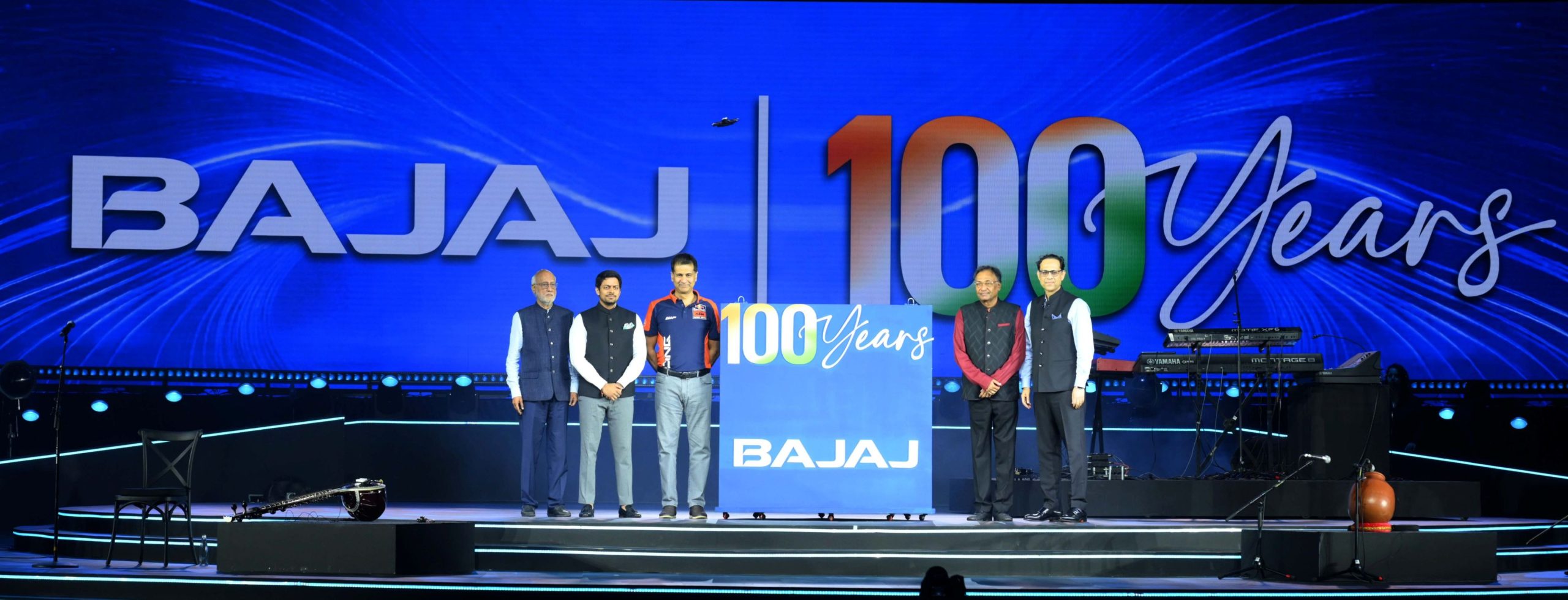
The centenary celebration at the National Sports Club of India in Mumbai brought together business leaders, politicians, celebrities, industry veterans, and members of the Bajaj family.
The evening featured:
- A specially composed live performance by Grammy-winning composer Ricky Kej
- Screening of Kathni Karni Eksi, a film on Jamnalal Bajaj and Mahatma Gandhi directed by Rajkumar Hirani
- Unveiling of the official “100 Years of Bajaj” logo
During his address, Sanjiv Bajaj emphasized the importance of technology, innovation, and artificial intelligence in India’s next growth phase. He stated that AI-driven financial inclusion could significantly improve access to opportunity across the country.
Meanwhile, Shekhar Bajaj reflected on the values of Jamnalal Bajaj, stressing that true success must also be measured through social impact, ethics, and community welfare.
Bajaj and India’s Economic Journey
The story of Bajaj mirrors India’s own industrial and economic evolution over the last century.
From supporting the Swadeshi movement and manufacturing scooters for middle-class India to building globally competitive financial and automotive businesses, the Group has remained deeply connected to India’s growth story.
Industry analysts believe Bajaj’s continued investments in electric mobility, fintech, healthcare, and digital ecosystems could position the conglomerate strongly for the next phase of India’s economic transformation.
As India aims to become a developed economy by 2047, legacy institutions like Bajaj are expected to play a key role in manufacturing expansion, employment generation, technological innovation, and sustainable development.
Conclusion
The Bajaj Group’s 100-year journey represents far more than

corporate success. It reflects a rare blend of entrepreneurship, nationalism, ethical leadership, and social responsibility.
From the ideals of Jamnalal Bajaj during India’s freedom struggle to its current position as a global industrial powerhouse, the Group continues to shape India’s economic and social landscape.
With expansion into healthcare, increased focus on sustainability, and investments in future technologies, the next century of Bajaj appears set to be as transformative as its first.



Deprecated: file_exists(): Passing null to parameter #1 ($filename) of type string is deprecated in /home/sqqexgsj/puneinsight.com/wp-includes/comment-template.php on line 1624